AI for Dealership Lead Management: What Actually Breaks, and What AI Can Fix
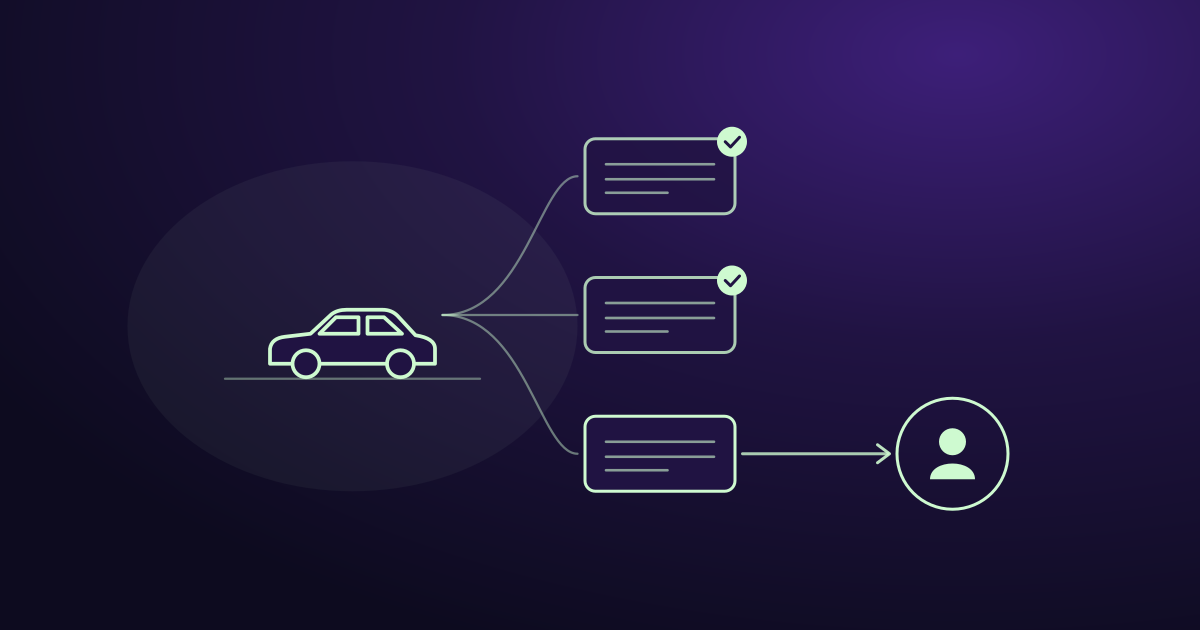
AI for dealership lead management can fix one real problem: inquiries that need a person and never reach one. It won’t fix response speed, because most dealers have already fixed that themselves. Here’s what the 2026 data shows, what to test before you buy, and where AI makes things worse.
Dealers already fixed the speed problem
Almost every pitch for AI in dealership lead management opens the same way. You’re too slow, and slow kills deals. That used to be true. It’s much less true now.
Pied Piper’s 2026 Internet Lead Effectiveness study sent real inquiries to 3,290 dealership websites. Each one asked about a car confirmed to be in stock. The study then tracked every channel for 24 hours.
The industry average hit 71 out of 100, up six points in a year. Half of dealers (51%) gave what the study calls a perfect response: a fast answer through more than one channel. Five years ago, that share was half as high.
The habits behind the jump aren’t exotic:
| Habit | 2025 | 2026 |
|---|---|---|
| Answered the question by text | 38% | 54% |
| Phoned the customer | 67% | 75% |
| Did both | 49% | 62% |
| Failed to respond at all (best brands) | not reported | under 3% |
More texting, more calling, and more of both together. If a vendor promises to cut your first response from two hours to five minutes, check your own numbers first. You may already be winning that race.
The same study found where dealers still lose. It isn’t on the clock.
The leads that need a person are the ones that disappear
For a routine question, dealers answered within 24 hours 78% of the time. For a question that needed real human thought, that dropped to 51%. Those harder inquiries were also twice as likely to get no personal response at all.
That flips the usual story. The easy lead, the one a template could handle, gets handled. The lead asking about a trade-in, a finance structure or an out-of-state purchase goes quiet. Those aren’t the cheap leads. They’re the ones with a buyer attached.
The handoff is where it breaks. Automation answers what it can, hits something it can’t, and passes it to a person. Whether anyone picks it up is a separate question. Pied Piper’s Cameron O’Hagan said teams assume someone will step in when automation fails. “Too often, no one does.”
The second failure is quieter. Data moves between the website, the DMS, the CRM, the AI tool and whatever sends the email. It doesn’t always arrive intact. A response gets triggered, but the customer’s actual question never gets answered. The CRM logs a touch either way.
That’s the real problem: your dashboard can’t see any of this. It records activity, not resolution. Your reports can look healthy while your best inquiries go cold.
AI for dealership lead management is three different jobs
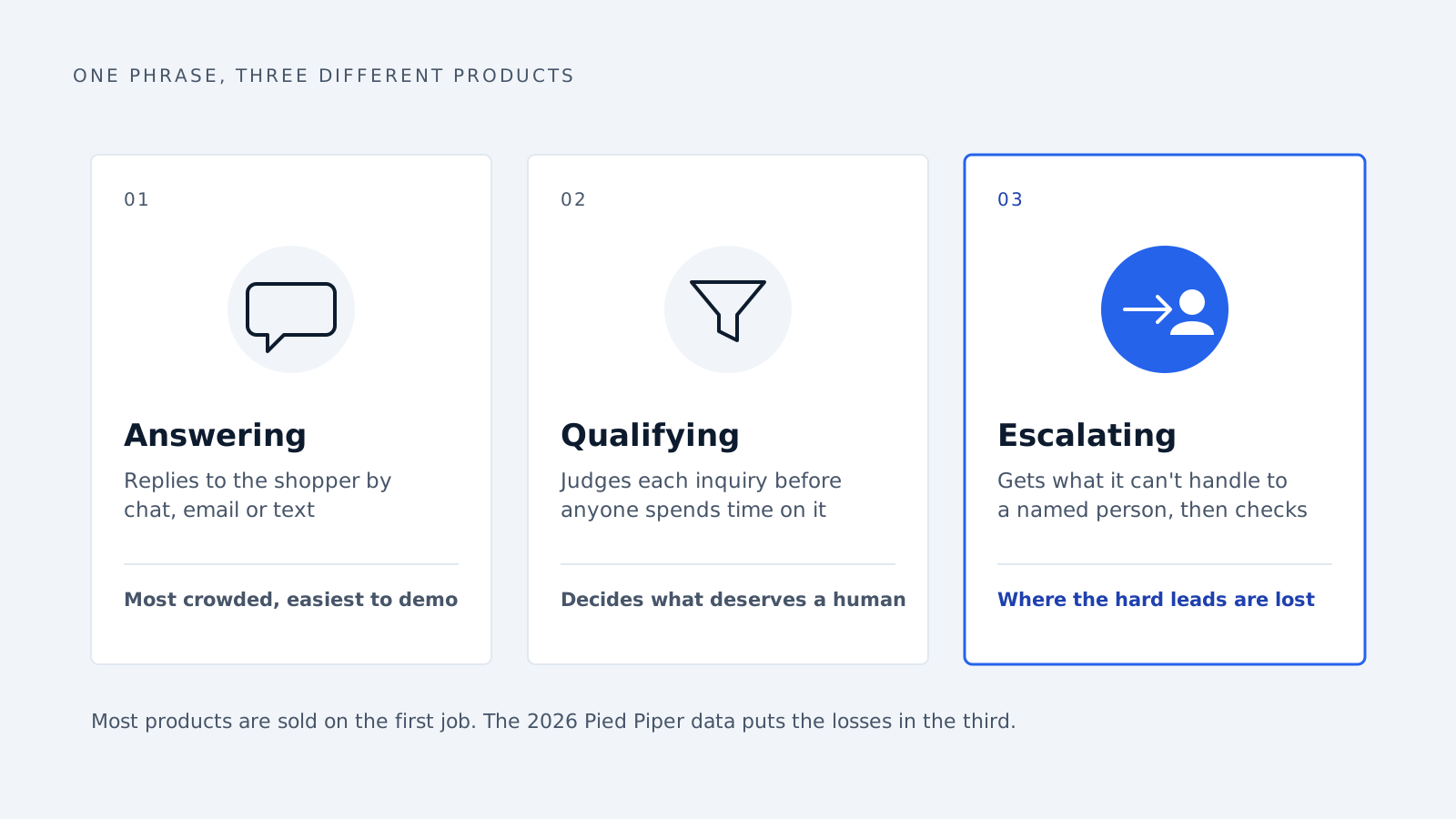
Vendors use one phrase for three different products. Knowing which one you’re looking at is most of the buying decision.
Answering. The AI replies to the shopper by chat, email or text. This is the most crowded part of the market and the easiest to demo. It’s also the job dealers have already improved most. So buying more of it moves your numbers least.
Qualifying. The AI judges each inquiry before anyone spends time on it. Is this a buyer, a competitor or a scraped list? Is it a service question in the sales inbox, or the same person who came through three portals this morning? Qualifying decides what deserves a human. It doesn’t talk to anyone.
Escalating. The AI spots what it can’t handle and gets it to a named person, with the context attached, somewhere they’ll actually see it. Then it checks whether anything happened.
The Pied Piper data puts the losses in the third job. Most products are sold on the first. Buy answering when your leak is escalation, and you get a faster autoresponder, a nicer dashboard, and the same hard leads dying in silence.
One question cuts through any demo: what does the system do when it doesn’t know the answer? If the reply is about tone, fallback messages or how natural the AI sounds, you’re being sold answering.
Before you buy anything, mystery-shop your own store
This test is free and takes a weekend. It’s the same method Pied Piper uses: send inquiries and watch what happens.
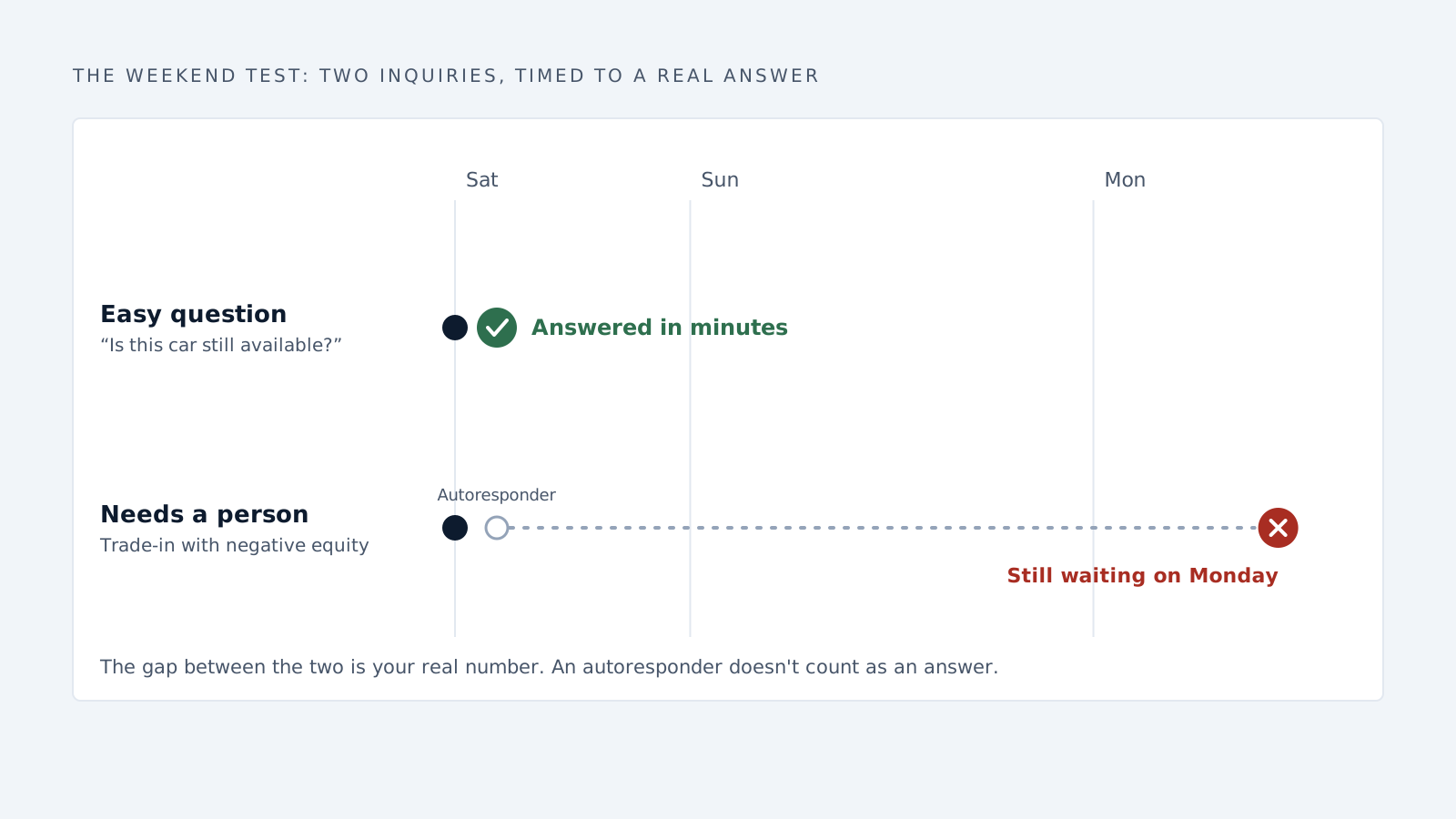
From an address nobody knows, send two inquiries through your own website form. Make the first one easy: “Is this car still available?” Make the second one need a person. Try a trade-in with negative equity (worth less than the loan on it), a specific finance question or an out-of-state purchase.
Time both until the first reply that actually answers the question. Not the autoresponder. The answer.
Most dealers find the easy one handled in minutes and the hard one still waiting on Monday. That gap is your real number, and no vendor can tell it to you.
Once you know it, ask vendors these five questions:
- Show me a lead the system chose not to escalate, and why. If there’s no written reason, there’s no judgment you can audit. Just a number you have to trust.
- What happens when a handoff fails? Someone should hear about it within the hour. If the lead just stays in a queue, you’ve bought a queue.
- How do you spot one buyer behind three leads? A shopper who hits your site, Autotrader and Cars.com in one evening is one person. A system that sees three will call them three times.
- Where does our customer data go, and who trains on it? Get the answer in writing.
- What does it get wrong? A vendor who can’t name a failure mode hasn’t looked or won’t say. Either should cost them the deal.
Where AI makes things worse
Here are four ways an AI tool can cost you money.
Replying to everything. An instant reply to every inquiry lifts your response rate on paper. It also teaches shoppers that your first message is noise. Pied Piper stopped counting autoresponders as an answer years ago. Buyers did the same without being told.
Confident scores on thin evidence. A name, an email and a car of interest aren’t much to judge someone on. A system that turns that into a firm number is faking certainty. A score with written reasons can be argued with. A bare score can’t.
Automating escalation without staffing it. This is the failure in the 2026 data, and AI can make it worse. When a system looks like it’s handling things, people stop feeling responsible. Someone has to own the exceptions by name, or they’re nobody’s.
Buying a filter instead of fixing the source. If a third of your inquiries are junk from one portal, that’s a contract problem, not a tech problem. Find out where the junk comes from before you pay anyone to sort it. The cheaper fix is often a call to your portal rep.
The honest limit: AI is good at reading everything that comes in and bad at knowing your market. A salesperson who’s worked the same town for ten years will beat any model on the lead that looks wrong on paper. The goal is to stop that person drowning in the other ninety, not to replace their judgment.
How we built ours
Delynt builds an AI layer that sits on your sales inbox. We built it for qualifying and escalating, not for answering.
Every inbound message gets read. Obvious automated mail (no-reply senders, newsletters, receipts, job alerts) is dropped before any AI model runs. That keeps costs down and keeps noise out of your notifications.
Every message that gets through gets a trust score and a spam score, with the reasoning written in plain English. So a sales manager can disagree with it.
Results reach people where they already work, not in another tab. You can route by inbox or company-wide, so a rep sees their own leads and an owner sees everything.
Replies are drafted and shown first. They’re sent only when a person approves them. That limit is deliberate, for the reasons in the section above.
Want to compare it against your own mystery-shop numbers? Let’s talk.
Sources
- 2026 Pied Piper PSI Internet Lead Effectiveness Auto Industry Study: 3,290 dealership websites, 33 brands, responses tracked across email, phone, chat and text for 24 hours after each inquiry.
How we write, source and correct our articles:editorial policy.
Related reading

AI for Freight Brokers: Where It Wins Loads, and Where It Doesn't
Big brokers answer email quotes with AI in two minutes. What a small brokerage can automate today, where AI catches freight fraud, and what to keep human.

AI Marketing for Lawyers: What Works, What Breaks, and What the Bar Rules Allow
Only 33% of law firms answer an emailed inquiry. Where AI marketing for lawyers pays off, where it breaks, and what the bar rules allow.

How to Use AI for Real Estate Agents
Most AI tools for agents are built for high-volume teams. Here is where AI helps a nine-deal-a-year agent, and where it creates fair housing and TCPA risk.
Ready when you are
See it read your own sales mailbox
Twenty minutes, on a real mailbox, with no slides. Gmail, Google Workspace, Outlook and Microsoft 365.