AI Marketing for Lawyers: What Works, What Breaks, and What the Bar Rules Allow
AI marketing for lawyers means using AI to attract, answer and convert prospective clients: writing content, running ads, showing up in AI search, and handling the inquiries those channels produce. Most of what is sold under the label sits at the start of that chain. For most firms, the measurable gains sit at the end, after a prospect has already reached out.
The reason is in the data. In the secret-shopper study behind Clio’s 2024 Legal Trends Report, only 33% of US law firms replied to a prospective client’s email, and 48% could not be reached by phone at all. A firm that misses half its inquiries does not have a traffic problem, and more AI-written blog posts will not fix it.
This guide covers what AI can do across a law firm’s marketing, where it pays off, where it breaks, and which bar rules decide what you are allowed to use. It is written for managing partners, marketing leads and solo practitioners deciding where the next dollar of AI spend should go.
This article is general information, not legal advice. Advertising and confidentiality rules vary by state; check your own jurisdiction’s rules and ethics opinions.
What does AI marketing for lawyers actually cover?
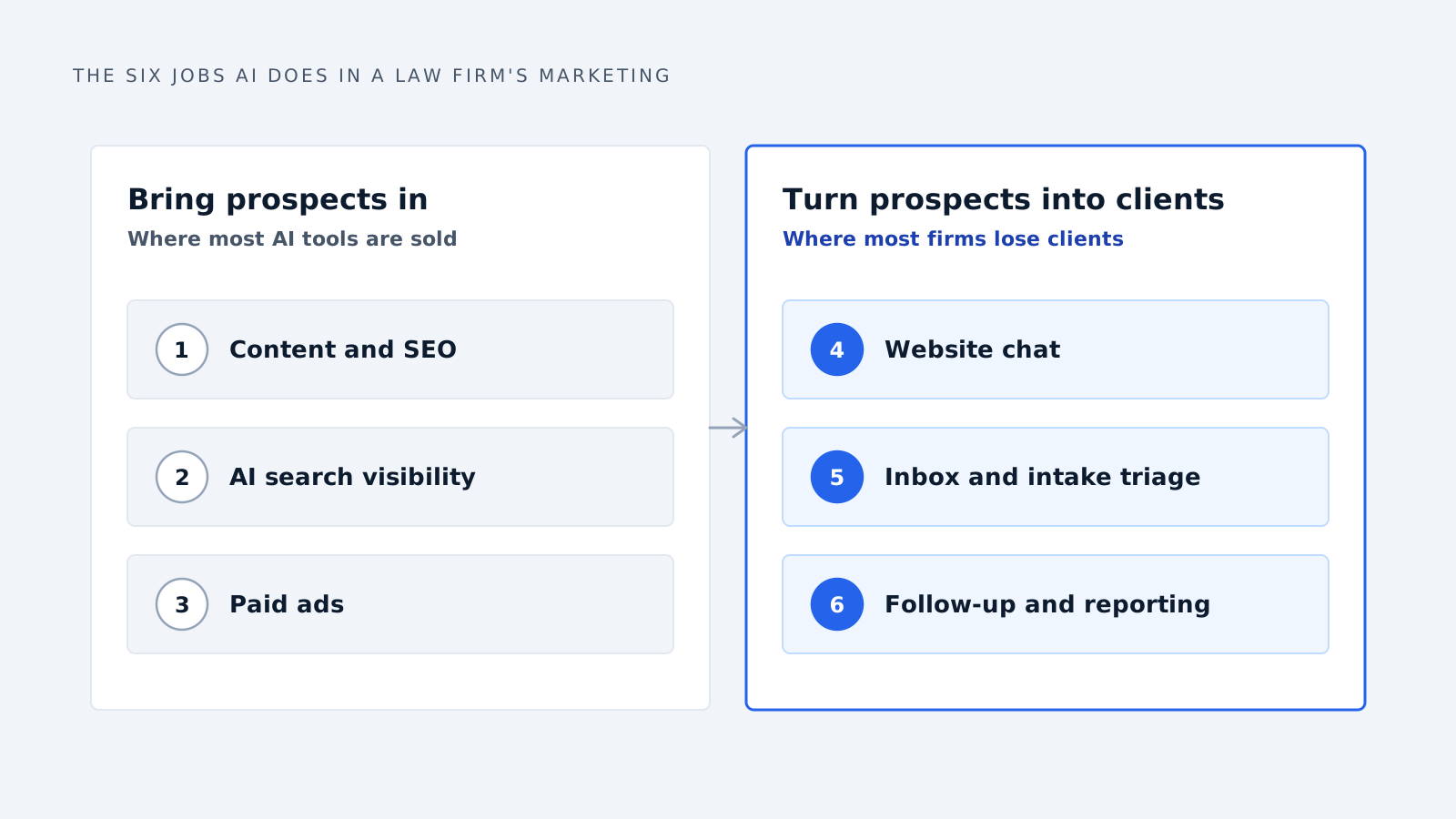
AI touches six jobs in a law firm’s marketing. The first three bring prospects in; the last three decide whether those prospects become signed clients.
| Job | What AI does well | What the lawyer still owns | Rules to watch |
|---|---|---|---|
| Content and SEO | Outlines, first drafts, FAQ sections, schema markup, refreshing old pages | Legal accuracy, any claim about results or specialization, final sign-off | Model Rules 7.1, 7.2(c) |
| AI search visibility | Checking how ChatGPT, Gemini and AI Overviews describe the firm; finding inconsistent directory and profile data | The truth of every claim those sources repeat | 7.1 |
| Paid ads | Bid automation, ad variations, audience testing | Ad claims, state filing and labeling rules, which conversions the algorithm is told to chase | 7.1, 7.2, state filing rules |
| Website chat | Answering common questions, collecting contact details, booking consultations around the clock | Disclaimers, scripts, no legal advice, screening out people who already have a lawyer | 7.1, 1.18, 5.5 |
| Inbox and intake triage | Separating real inquiries from spam and vendor mail, drafting first replies, routing by practice area, logging to the CRM | What gets promised, conflicts, who is accepted | 1.6, 1.18, 5.3 |
| Follow-up and reporting | Chasing stalled consultations and unsigned agreements; reporting cost per signed case by channel | What counts as success, who sees prospect data | 1.6, 7.3 |
Most of what is marketed as AI for law firms sits in the first three rows, because content and ads are easy to demo. The data in the next section says most firms lose their clients in the last three.
Where law firm marketing actually loses money
The biggest measurable leak in law firm marketing is the first reply. For its 2024 Legal Trends Report, Clio hired a research firm to contact 500 US law firms as prospective clients, by email and by phone. Here is what they found:
| What the shoppers tested | Result |
|---|---|
| Firms that replied to an emailed inquiry | 33% |
| Emailed firms that answered questions on next steps or expected cost | 18% |
| Firms that picked up the phone | 40% |
| Firms unreachable by phone, even after a message was left | 48% |
| Phone conversations that explained the process and next steps | 36% |
| Phone conversations that gave an estimate of total cost | 12% |
| Shoppers who could find pricing on the firm’s website | 14% |
| Shoppers unlikely to recommend the firm they reached | 73% |
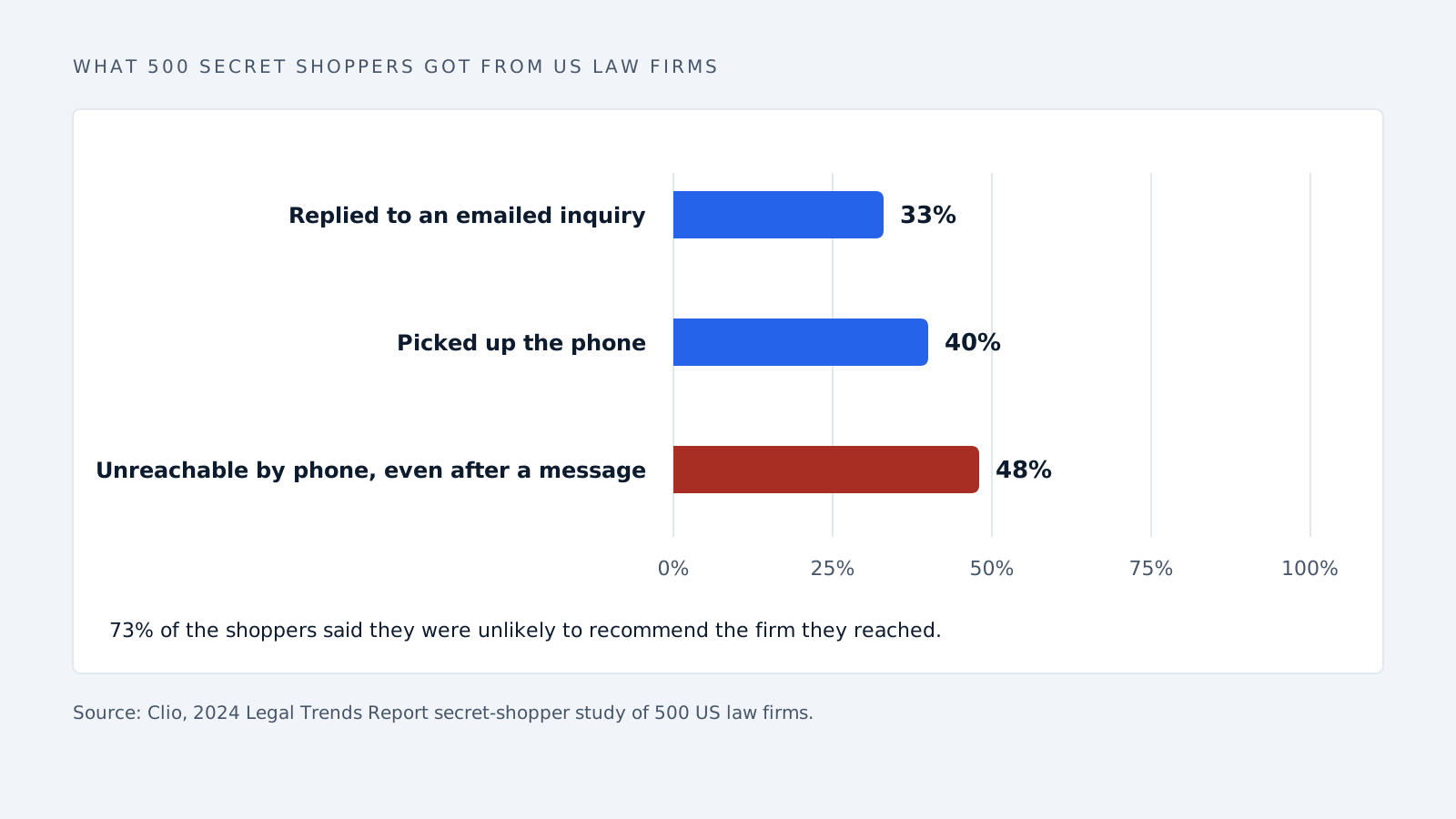
Two separate problems sit in that table. The first is silence: two in three email inquiries got no answer. Clio puts that against its finding that 79% of prospective clients expect a reply within 24 hours. The second is that even the firms that replied mostly did not answer what the prospect asked: what happens next, and what it will cost.
The prospect has also done more homework than before. In Clio’s 2025 consumer research, 57% of people said they have used or would use AI to answer a legal question. Of those who did, 28% were told by the AI to contact a lawyer, and 12% concluded their issue was not worth pursuing. Your first reply now competes with the answer a chatbot already gave. A reply that only says “call us to discuss” adds nothing to it.
This changes how a firm should judge its marketing spend. Cost per lead rewards volume. Cost per signed case shows what happens to those leads, and a lead that never gets a reply has a cost and no chance of a return.
A note on numbers you will see elsewhere: many articles claim that replying within five minutes converts 8 or 21 times better, citing Clio. We could not find either figure in the Clio reports we reviewed, so this article does not use them.
What AI can fix, and what it can’t, from inquiry to signed case
AI is useful at every step between an inquiry arriving and an engagement letter being signed. At each step there is also a point where it has to stop and hand over to a person.
1. Sorting the inbox
An intake inbox mixes new inquiries with vendor pitches, spam, existing clients, opposing counsel and court notices. AI can classify each message, score it for trust and spam, and route it by practice area and urgency.
Where it breaks: the expensive mistake is filing a real prospect as junk. A low score should push a message down the queue, never delete it, and someone should scan the low-scored pile daily. Mail from existing clients and opposing counsel must never receive a marketing reply.
2. The first reply
AI can draft a reply within minutes, at any hour, that answers what the Clio shoppers mostly did not get: what happens next, how consultations work, how the firm charges, and what to bring. It draws that from content the firm has approved in advance.
Where it breaks: anything that reads as advice on the prospect’s own situation, any prediction of outcome, and any fee the firm has not approved. A plain acknowledgment can go out automatically. Anything substantive should wait for a person to approve it.
3. Qualifying and checking conflicts
AI can pull the matter type, location, opposing parties and any mentioned deadlines out of a message and check them against the firm’s intake criteria.
Where it breaks: the conflicts check runs against the firm’s own records and a person confirms it. Intake should also collect only what the firm needs to check conflicts and decide; the next section explains why. A declined matter needs a careful non-engagement message, which AI can draft and a lawyer sends.
4. Booking the consultation
Offering times, confirming and sending reminders is safe to automate almost entirely.
5. Following up
AI can chase unscheduled consultations, unreturned intake forms and unsigned engagement letters with messages the firm wrote, and stop the moment the prospect replies.
Where it breaks: following up with someone who said no or hired another lawyer, and messaging people who never contacted the firm. The second is solicitation, which has its own rules.
6. Reporting
AI can join each inquiry to its source, consultation, signed matter and fee, which gives cost per signed case by channel. It can also answer plain questions such as “which practice area converted worst last quarter?”
Where it breaks: the answer is only as good as the source tagging in the CRM. If half the leads are logged as “website”, no AI will tell you which campaign brought them.
Two ways to buy this
Practice-management vendors are building these steps into their own products. In August 2026 Clio launched Grow AI, which answers phone, email and website chat inquiries, scores leads against the firm’s criteria and conflict rules, and charges $25 per converted lead. A firm already running its matters on one platform will often get the tightest conflicts integration there.
The other route is an AI layer that sits on the firm’s existing mailboxes and CRM. That suits firms with several inboxes, a general-purpose CRM, or intake spread across people. Delynt works this way. Either route has to pass the same rules, which come next.
The bar rules that decide which AI you can use
No state bar bans AI in law firm marketing. The rules decide which tools you can use and how you have to set them up. Five issues cover most of it. References below are to the ABA Model Rules; your state’s version governs and may differ.
Prospect information is confidential before anyone is hired
Under Model Rule 1.18(b), a lawyer may not use or reveal what a prospective client shared, even when no engagement follows. ABA Formal Opinion 512, issued July 29, 2024, applies the confidentiality duty to generative AI and extends it to prospective clients. Before entering client information into an AI tool, a lawyer has to weigh the risk that it will be disclosed or accessed by others. For a tool that learns from what it is given, the opinion requires informed client consent first, and boilerplate in an engagement letter does not count.
An AI tool that reads your intake inbox is processing prospective-client information from the first email. You cannot get informed consent from someone before they write to you, so in practice the tool must not train on that data, pool it with other customers’ data, or share it beyond what the service needs.
Collect less at intake
Rule 1.18(c) can disqualify a lawyer, and potentially the firm, from acting against a former prospect if the lawyer received information that could be significantly harmful in the same or a related matter. Comment 4 to the rule advises limiting the initial consultation to what is reasonably needed to decide whether to take the matter.
That cuts against how many AI chatbots and intake forms are designed, which is to get the whole story up front. Ask for the parties and the type of matter first, run conflicts, and only then go deeper. Comment 2 adds that a website inviting people to submit details, without clear warnings limiting the firm’s obligations, can create a consultation. Put those warnings on the form and the chat window.
Anything AI writes is your advertising
Model Rule 7.1 bars false or misleading communications about a lawyer’s services. It applies to an AI-written blog post, ad, chatbot answer or review request exactly as it applies to anything a partner writes, and the duty stays with the lawyer when an agency or a tool does the drafting. Two related rules catch AI drafts often:
- Rule 7.2(c) forbids stating or implying that a lawyer is a certified specialist unless an approved body certified them and is named. AI writers use “specialist” and “expert” freely.
- Rule 7.2(d) requires every communication to name at least one lawyer or firm responsible for its content.
Rules 5.1 and 5.3 make the firm responsible for supervising the people and tools that produce this work, and Opinion 512 applies that supervision duty to AI vendors.
Website chatbots must say they are not lawyers
Florida Bar Ethics Opinion 24-1 (January 19, 2024) says a chatbot that talks to prospects must follow advertising rules and include a disclaimer that it is an AI program, not a lawyer or firm employee. The lawyer is responsible if it misleads anyone. The opinion also warns against bots that are so welcoming they drift into legal advice, and suggests screening questions that stop the conversation if the person already has a lawyer. A bot that answers legal questions for visitors in states where the firm is not licensed also raises unauthorized-practice concerns under Rule 5.5.
Disclosure is also what prospects want: in Clio’s consumer research, 78% said they want lawyers to disclose AI use.
State rules multiply with AI volume
Some states, including Florida and Texas, require many advertisements to be filed with the bar. Others require labels such as “Attorney Advertising” or require firms to keep copies. A tool that produces dozens of ad variations multiplies that work, so check how your state treats variations before switching on automated ad testing. Outreach to people who never contacted the firm is solicitation under Rule 7.3, and some states add labeling or filing rules for it.
AI-written content and AI search: where generic writing hurts
AI makes law firm content cheap to produce, which is why most of it now adds little. In Clio’s research, 53% of consumers who asked an AI a legal question felt it answered them sufficiently. A page that explains what probate is competes with that free answer and usually loses.
Prospects still research before they call. Martindale-Avvo’s 2026 legal consumer report found 92.4% are likely or very likely to research their issue online before contacting a lawyer, increasingly by asking an AI rather than scanning a list of links. What gets a firm into those answers, and what makes a prospect choose it, is information only that firm has:
- How a consultation works, what it costs, and what happens after it
- Local procedure: which court hears the matter and typical timelines in your county
- Attorney credentials anyone can verify: bar admissions, published work, recognitions with the issuer named
- Fee structures and payment options, which only 14% of Clio’s shoppers could find on firm websites
AI answers are assembled from whatever they can find about your firm. When your website, Google Business Profile and directory listings disagree on practice areas, offices or which attorneys work there, inconsistent answers become more likely. AI is good at this audit: pull every listing, compare the facts, and flag the differences.
Keep AI drafting on a short leash:
- AI drafts; a lawyer checks every statement of law, deadline and citation. A wrong statute of limitations in a blog post is bad information and a misleading communication.
- Strip “specialist”, “expert”, “best” and any outcome language unless it meets Rule 7.2(c) and your state’s rules.
- Add the responsible lawyer’s name, a last-reviewed date and author markup, so readers and search engines can see who stands behind the page.
Questions to ask before you buy any AI marketing tool
Ask these of every vendor, including us. A vendor that cannot answer them in writing is not ready to handle a law firm’s intake.
| Question | Why it matters | A good answer |
|---|---|---|
| Does anything train on our data, or pool it with other customers’ data? | Opinion 512 requires informed consent for self-learning tools, and you cannot get it from a prospect before they write to you | No training and no pooling, stated in the contract, not only in an FAQ |
| Which AI model providers process our data, and on what terms? | Your data travels past the vendor to its model provider, and Rule 5.3 supervision covers that chain | Named providers, limited or zero retention, a data processing agreement on request |
| How long is prospect data kept after a matter is declined? | Rule 1.18 duties outlast the inquiry | A defined retention period and a deletion process |
| Can it send anything without a person approving it? | Rule 7.1 responsibility stays with the lawyer | Approval rules you set; automatic sending limited to messages you wrote |
| What happens to mail it scores as junk? | A misfiled prospect is a lost case | Pushed down the queue, never deleted, always reviewable |
| How much does it ask a prospect at first contact? | Rule 1.18(c) disqualification risk | Configurable intake that asks conflicts questions first |
| Does the chat window say it is AI, and stop if the person has a lawyer? | Florida Opinion 24-1 and similar guidance | Both built in and logged |
| How do we revoke its access? | You stay in control of your systems | Self-serve, through the provider’s own settings, effective immediately |
| Can it report cost per signed case by channel? | Cost per lead hides where money is lost | Source tracked from first inquiry through to signed matter |
Delynt publishes its answers to several of these on its security page.
A practical first 30 days
Start with the step closest to revenue, measure it, and only then add more. Most firms already use AI somewhere; in Clio’s 2026 research, 71% of solo practitioners and 75% of small firms use it, yet fewer than a third have grown revenue with it. Pointing it at intake first ties it to the step closest to signed revenue.
- Week 1: secret-shop yourself. Send an email inquiry and call after hours, the way Clio’s shoppers did. Record how long the first reply took and whether it answered next steps and cost. Count last month’s inquiries by channel, and how many got a reply within 24 hours.
- Week 2: write the approved answers. Draft the firm’s standard content on how consultations work, fees, next steps, what to bring, and the disclaimers. Decide what AI may send on its own (a plain acknowledgment) and what needs a person’s approval (everything else).
- Week 3: switch on one inbox. Turn on triage and drafted replies for one practice area, with approval required. Set intake questions to ask for parties and matter type first. Confirm the vendor’s answers to the questions in the table above.
- Week 4: compare. Measure reply time, the share answered within 24 hours, consultations booked and matters signed against week 1. If the numbers moved, add follow-ups next, then content and ads.
Frequently asked questions
Is it ethical for lawyers to use AI in marketing?
Yes. ABA Formal Opinion 512 and Florida Bar Opinion 24-1 both treat AI as permitted, provided the lawyer follows the existing rules on confidentiality, supervision and advertising. The lawyer stays responsible for everything the AI produces or sends.
Does a law firm have to disclose that its website chatbot is AI?
Florida’s Ethics Opinion 24-1 says the chatbot must disclose that it is an AI program and not a lawyer or firm employee, and the misleading-communication rules behind that advice apply in every state. Prospects expect it as well: 78% of consumers in Clio’s research want lawyers to disclose their use of AI.
Can an AI chatbot create an attorney-client relationship?
It can create duties to a prospective client. Under Rule 1.18, inviting people to submit details without clear warnings can turn the exchange into a consultation, with confidentiality and conflict consequences. A bot that comments on the person’s own situation also risks giving legal advice the firm is responsible for.
Can I use ChatGPT to write my law firm’s blog posts?
Yes, as a drafting tool, if a lawyer checks every legal statement and claim before publishing and no client or prospect information goes into the prompt. Remove specialist and outcome language that Rules 7.1 and 7.2(c) do not allow.
What should a small firm spend on AI marketing first?
Response before reach. Measure how fast and how fully you answer inquiries today. If replies are slow or thin, intake triage and drafted replies are likely to return more than new content or ads, because they work on leads you have already paid for.
How much does AI marketing for law firms cost?
Pricing models vary: monthly subscriptions per user or mailbox, agency retainers, and pay-per-result pricing such as Clio’s Grow AI at $25 per converted lead. Compare options on cost per signed case rather than on the monthly fee.
Want to see this on your own intake inbox? Twenty minutes, on your own mailbox, with no slides. Talk to us.
Sources
- Are Law Firms Failing at Marketing and Client Engagement? — Clio, 2024 Legal Trends Report secret-shopper study
- What to Do About Legal Clients Using AI — Clio, 2025 Legal Trends Report consumer data
- Small Law Firms Lag Larger Peers on Using AI to Grow Revenue — Clio, 2026 Legal Trends for Solo and Small Law Firms
- Clio Grows Clio Grow with Launch of Grow AI — LawSites, August 20, 2026
- How AI Is Changing the Way Consumers Are Finding Lawyers — on Martindale-Avvo’s 2026 legal consumer report
- ABA Formal Opinion 512: Generative Artificial Intelligence Tools — American Bar Association, July 29, 2024
- Breaking Down the ABA’s Guidance on Using Generative AI — Illinois Supreme Court Commission on Professionalism
- Florida Bar Ethics Opinion 24-1 — The Florida Bar, January 19, 2024
- Florida Bar Advisory Opinion 24-1: Four Ethical Caveats — Hinshaw & Culbertson
- You or You Ain’t My Client — ABA Litigation Journal, on Model Rule 1.18
- How Prospective Client Consultations Could Impact You — Lawyers Mutual, on Rule 1.18 Comment 4
- Model Rule 7.2: Communications Concerning a Lawyer’s Services — American Bar Association
- FAQs on Attorney Advertising and Ethics Rules in the Digital Age — American Bar Association, Winter 2025
How we write, source and correct our articles:editorial policy.
Related reading

AI for Freight Brokers: Where It Wins Loads, and Where It Doesn't
Big brokers answer email quotes with AI in two minutes. What a small brokerage can automate today, where AI catches freight fraud, and what to keep human.
AI for Dealership Lead Management: What Actually Breaks, and What AI Can Fix
Dealers already fixed response speed. The 2026 data shows where leads still die: inquiries that need a person never reach one. What to test before buying AI.

How to Use AI for Real Estate Agents
Most AI tools for agents are built for high-volume teams. Here is where AI helps a nine-deal-a-year agent, and where it creates fair housing and TCPA risk.
Ready when you are
See it read your own sales mailbox
Twenty minutes, on a real mailbox, with no slides. Gmail, Google Workspace, Outlook and Microsoft 365.